
Exosomes, Salmon DNA & Minoxidil: Can This Combination Supercharge Hair Regrowth?
FEATURE – Exosomes, salmon DNA, minoxidil… Could combining these three elements create a "super serum" capable of activating follicles more effectively than minoxidil alone? That's what a recent mouse study suggests. Here's what it actually shows — and what it doesn't.
Table of Contents
1. Where does this study come from?
2. Exosomes and salmon DNA: what are they exactly?
3. How was the study conducted?
4. What the results show
5. How solid is this study?
6. Exosomes & salmon DNA: promise, risks, and regulation
7. Should you wait for this type of serum?
8. Key takeaways
9. An alternative available today
10. Scientific sources
1. Where does this study come from?
The paper — titled "Assessment of Trial to Use Exosomes and Salmon DNA with Minoxidil as Multisource Mixture for Hair Follicle Activation: An In Vivo Study" — was produced by an Egyptian research team at Benha University and published in the Benha Journal of Applied Sciences in 2025. It addresses a straightforward question: does adding exosomes and salmon DNA to minoxidil activate hair follicles more effectively?
One key point upfront: this is a preclinical study conducted exclusively on C57BL/6 mice — a standard model in hair research.
2. Exosomes and salmon DNA: what are they exactly?
Exosomes
Exosomes are tiny vesicles released by stem cells. They carry proteins, RNA, and regenerative factors capable of influencing other cells. Several research teams have shown that exosomes derived from mesenchymal stem cells can stimulate the proliferation of hair follicle cells in certain animal models.
Salmon DNA (PDRN)
PDRN (polynucleotides derived from salmon DNA) is already used in aesthetic medicine to improve skin regeneration. It has a recognised effect on tissue repair and may, according to several small studies, support the metabolism of hair follicle cells.
Minoxidil
Minoxidil remains the gold standard in topical treatments for hormonal hair loss (AGA). It improves microcirculation and extends the hair growth phase — though its efficacy is variable and sometimes limited.
3. How was the study conducted?
The researchers used C57BL/6 mice — a model chosen because their coat changes phase rapidly, making it easier to observe the effects of treatments. The protocol included:
- 7 groups receiving different mixtures: minoxidil alone, exosomes alone, salmon DNA alone, or combinations.
- Topical application over 10 days on a shaved area.
- Histological measurements (follicle count and size).
- Genetic analysis of two key hair genes: Wnt11 (follicle activation) and LHX2 (sustaining hair growth).
4. What the results show
1. Minoxidil alone: the expected improvement
As anticipated, mice treated with minoxidil alone showed a clear increase in follicle density, longer and better-developed follicles, and partial activation of growth-related genes.
2. Minoxidil + Exosomes + Salmon DNA: an amplified effect
The combination produced markedly stronger results:
- Follicle density increased significantly, well beyond that seen with minoxidil alone.
- Follicle size and thickness were visibly greater, suggesting stronger anagen activity.
- Key genetic markers Wnt11 and LHX2 were significantly more expressed, indicating more powerful activation of follicular stem cells.
The study suggests a possible synergy between minoxidil, exosomes, and salmon DNA — at least over a short period and in mice.
5. How solid is this study?
Strengths
- Aligns with other research showing exosomes stimulate follicular stem cells.
- Uses histological and genetic analyses, not just visual assessments.
- Consistent with known biological mechanisms (Wnt pathway, LHX2, proliferation).
Significant limitations
- Conducted on mice only, over just 10 days.
- No clinical validation in humans.
- Published in a local journal with limited international reach.
- Results have not been reproduced by other teams.
- Long-term effects are not measured.
6. Exosomes & salmon DNA: promise, risks, and regulation
Human-derived exosomes are currently banned in cosmetics in Europe and the UK, subject to strict medical requirements, and classified by many regulators as Advanced Therapy Medicinal Products (ATMPs). Polynucleotides (PDRN) are used in some aesthetic procedures, but their efficacy against baldness remains very poorly documented in humans.
7. Should you wait for this type of serum?
It's too early to talk about a future pharmacy treatment. Several steps are missing: toxicity testing, stable dosages and formulations, Phase 1/2/3 clinical trials, and regulatory approval. This is clearly a preclinical proof of concept — encouraging, but still far from a practical application.
8. Key takeaways
- The study shows that minoxidil + exosomes + salmon DNA stimulates follicles more strongly than minoxidil alone (in mice).
- Key genetic growth markers (Wnt11, LHX2) were significantly upregulated.
- But this is a short, animal-only, unreplicated study.
- No clinical conclusions for humans can be drawn at this stage.
- Human exosomes are not authorised in cosmetics in Europe.
9. An alternative available today
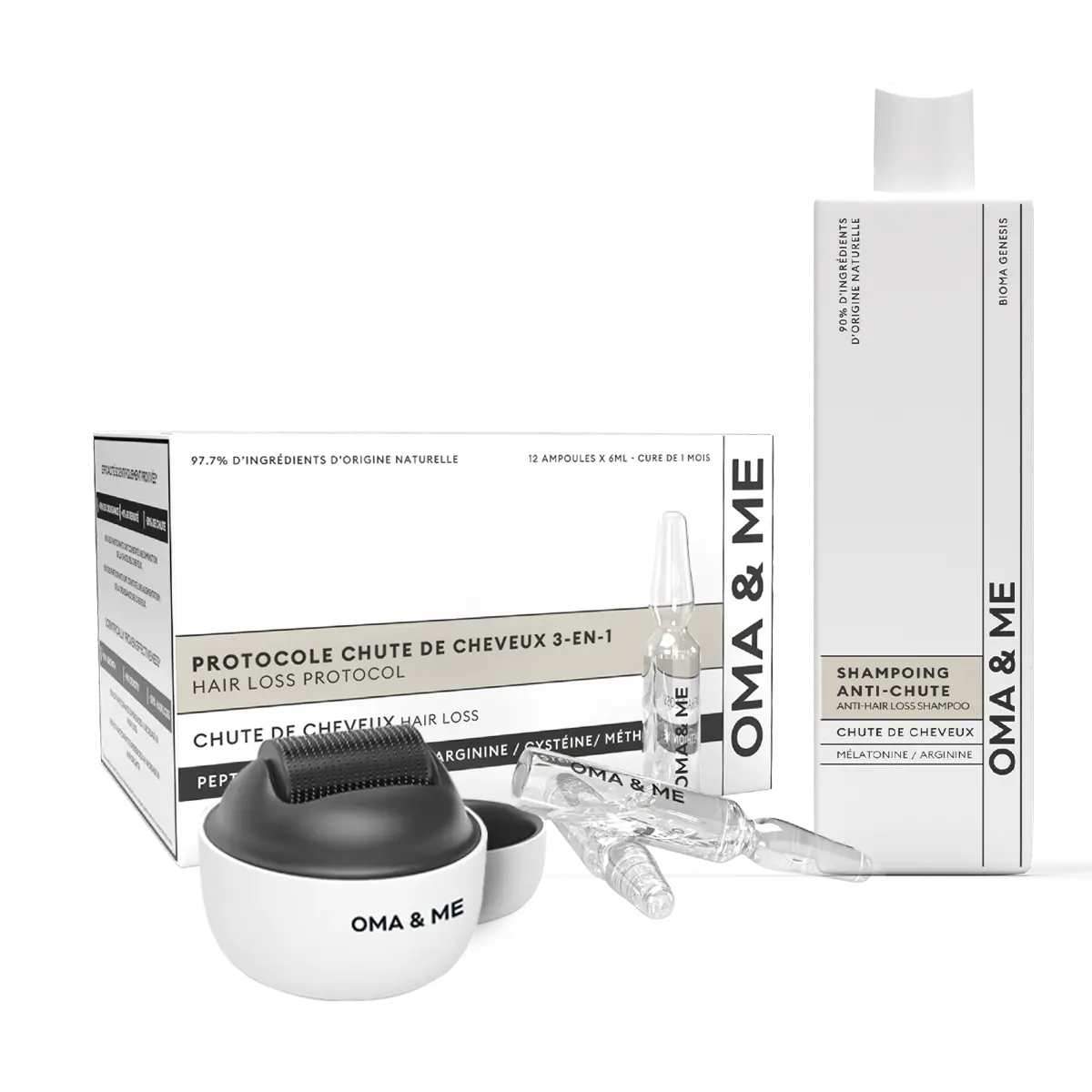
While solid clinical validation of exosomes or polynucleotides is still pending, you can act now with a non-pharmaceutical but scientifically supported solution: the OMA & ME 3-in-1 Hair Loss Protocol. It combines pre-/post-biotics, amino acids, zinc, and melatonin to support follicle activity over 90 days.

10. Scientific sources
- Abdelaziz A.M. et al. (2025). Assessment of Trial to Use Exosomes and Salmon DNA with Minoxidil as Multisource Mixture for Hair Follicle Activation. Benha Journal of Applied Sciences.
- Lopez et al. – Reviews on exosomes and follicular regeneration.
- Preclinical studies on polynucleotides (PDRN) and skin regeneration.
- Review articles on regulatory limitations of exosomes in cosmetics (EU/UK, 2023–2024).
-
Example product title
Regular price €19,99Sale price €19,99 Regular priceUnit price per -
Example product title
Regular price €19,99Sale price €19,99 Regular priceUnit price per -
Example product title
Regular price €19,99Sale price €19,99 Regular priceUnit price per


