
Melatonin and Hair Loss: the Anti-Shedding Active Validated by Science
INFORMATION – Known to the general public as "the sleep hormone", melatonin is emerging as one of the most promising actives in the fight against hair loss. Clinical studies conducted on more than 2,000 patients show that when applied directly to the scalp, it extends the hair growth phase, reduces shedding and improves hair density — all without notable side effects. A closer look at a game-changing active.
Contents
- Melatonin in a nutshell
- What melatonin actually does for your hair
- Clinical study results
- Topical vs oral melatonin: what's the difference?
- What you should know before you start
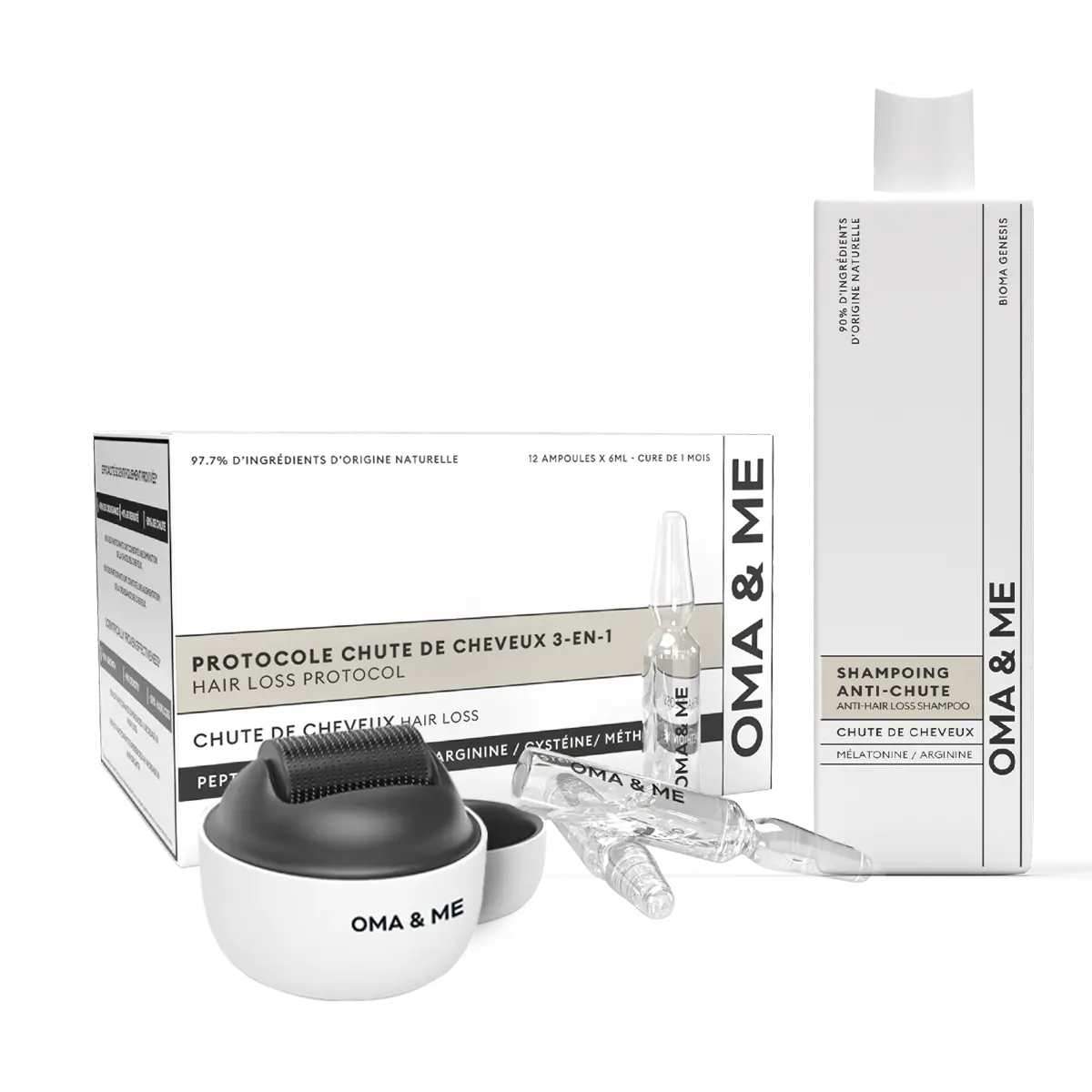
- The OMA & ME 3-in-1 Protocol: melatonin already built in
- Sources
Melatonin in a nutshell
Melatonin is a hormone naturally produced by the brain (in a small gland called the pineal gland). Its best-known role: regulating the sleep-wake cycle. When light fades in the evening, your body produces more of it to help you fall asleep.
But that's only part of the story. Melatonin is also a powerful antioxidant, capable of neutralising the free radicals that damage cells. It also plays a role in regulating inflammation and hormonal modulation. It is precisely this versatility that has attracted researchers in trichology (the science of hair) for the past twenty years.
What melatonin actually does for your hair
A founding discovery: the hair follicle has its own melatonin receptors
This is the discovery that changed everything. The work of Dr Tobias Fischer and his team, published in the Journal of Pineal Research in 2008, showed that the human hair follicle is not a passive receiver of circulating melatonin: it has its own membrane receptors (MT1) and nuclear receptors (RORα), and is even capable of synthesising its own melatonin during the active hair growth phase (anagen phase).
In other words, melatonin is part of the hair's internal machinery. When its levels drop, the hair cycle is directly affected.
Four identified mechanisms of action
Two decades of accumulated research paint a fairly clear picture of how melatonin acts on hair:
1. It extends the growth phase (anagen). This is the most documented effect. Melatonin helps keep follicles in their active phase for longer, notably by activating the Wnt/β-catenin pathway — a key molecular signal that instructs the follicle to produce hair.
2. It protects follicle cells. Dermal papilla cells (the follicle's "engine") are among the most metabolically active in the human body. They produce high levels of free radicals. Melatonin, as an antioxidant, neutralises these harmful molecules and stimulates defence enzymes such as superoxide dismutase.
3. It counteracts the effects of DHT. Dihydrotestosterone (DHT) is the hormone responsible for the progressive miniaturisation of follicles in androgenetic alopecia (common baldness). Recent research suggests that melatonin can reduce the sensitivity of androgen receptors by displacing them from the cell nucleus — a mechanism complementary to finasteride, which blocks DHT production upstream.
4. It reduces local inflammation. Chronic scalp inflammation is an aggravating factor in many forms of hair loss. The anti-inflammatory properties of melatonin help maintain an environment conducive to hair growth.
How does melatonin compare to minoxidil and finasteride?
Minoxidil (topical) and finasteride (oral) remain the two reference treatments approved by health authorities (FDA, EMA) for androgenetic alopecia. They have a high level of evidence, but also come with constraints:
| Minoxidil | Finasteride | Topical Melatonin | |
|---|---|---|---|
| Primary mechanism | Vasodilation, follicle stimulation | Blocks testosterone → DHT conversion | Antioxidant, anagen prolongation, local hormonal modulation |
| Administration | Topical (2× / day) | Oral (1 tablet / day) | Topical (1× / day, in the evening) |
| Duration of use | Lifelong to maintain results | Lifelong to maintain results | 3 to 6-month course (current data) |
| Reported side effects | Scalp irritation, increased heart rate (rare) | Reduced libido, gynaecomastia (rare but documented) | Excellent tolerability, no major side effects reported in studies |
| Level of evidence | High (numerous randomised trials) | High (numerous randomised trials, men only) | Promising (positive clinical studies, but few large-scale double-blind trials to date) |
| Availability | Pharmacy (no prescription required) | Prescription only (men) | Integrated into certain cosmetic products (e.g. OMA & ME Protocol) |
Topical melatonin does not claim to replace these reference treatments. Its value lies in its remarkable tolerability profile, its complementary action (notably antioxidant and anti-inflammatory), and the ability to integrate it into a care routine without side effects. For those who do not wish to use pharmaceutical treatments, it represents a credible option backed by encouraging clinical data.
Clinical study results
Key takeaways at a glance
The accumulated results on topical melatonin are consistent:
→ 8 out of 11 studies report positive effects on hair regrowth, according to a literature review published in 2023 in the Journal of Drugs in Dermatology, covering a total of 2,267 patients.
→ Increase in hair density observed in 54 to 58% of treated patients (up to +41% density after 6 months).
→ Dramatic reduction in shedding measured by the hair-pull test: in a multicentre study involving more than 1,800 volunteers, the percentage of patients with a strongly positive traction test dropped from 61.6% to just 7.8% after 3 months.
→ Excellent tolerability across all studies, with no significant influence on blood melatonin levels.
Key studies in detail
| Study | Year | Type | Participants | Key results |
|---|---|---|---|---|
| Fischer et al. (Br J Dermatol) | 2004 | Randomised, double-blind, placebo-controlled trial | 40 women (androgenetic or diffuse alopecia) | Significant increase in the proportion of hairs in anagen phase in the occipital area (P=0.012). Plasma melatonin levels remained within physiological limits. |
| Fischer et al. (Int J Trichology) | 2012 | Compilation of 5 clinical studies | ~1,900 men and women | Reduction in positive hair-pull test from 61.6% to 7.8%. Increase in hair density of 29% to 41% (TrichoScan). Associated reduction in seborrhoea. |
| Gupta et al. (J Drugs Dermatol) | 2023 | Literature review (11 studies) | 2,267 patients | 8 out of 11 studies report improvement in hair growth. Effective dosages: topical solution at 0.0033% or 0.1%, 1 application/day for 90 to 180 days. |
| Greco et al. (Int J Mol Sci) | 2024 | Review of topical clinical trials | — | Confirms the potential of topical melatonin for certain forms of alopecia, particularly in women. Highlights the need for larger-scale trials. |
| EJGM Review | 2025 | Scoping review (preclinical + clinical) | — | Topical melatonin increases density, extends anagen and reduces shedding with a favourable tolerability profile. |
Topical vs oral melatonin: what's the difference?
This is a common question, since many people are already familiar with melatonin in tablet form for sleep. But when it comes to hair, the route of administration makes all the difference.
Topical melatonin (applied to the scalp) is the only form conclusively studied for hair loss. It acts directly where the follicle's MT1 receptors are located, without entering the general circulation. Pharmacokinetic studies have shown that blood melatonin levels remain within the normal nocturnal physiological range, even after daily application.
In contrast, oral melatonin has not been the subject of sufficient clinical studies to be recommended for the treatment of hair loss. Taking melatonin tablets is primarily aimed at improving sleep and does not guarantee that the molecule reaches the scalp at an effective concentration.
What you should know before you start
Topical melatonin is a well-tolerated active with a reassuring safety profile according to all available studies. A few points are worth keeping in mind:
The most documented results relate to androgenetic alopecia and diffuse hair loss.
The formulations tested in studies sometimes combine melatonin with other actives (biotin, ginkgo biloba, etc.), making it difficult to evaluate the effect of melatonin alone. But this "multi-active" approach is also what makes certain protocols particularly effective — such as the OMA & ME protocol, which combines melatonin with complementary ingredients to maximise results.
Finally, the right reflex: if you notice rapid, sudden or unusual hair loss, consult a dermatologist. They can make a precise diagnosis (androgenetic alopecia, nutritional deficiency, thyroid disorder, etc.) and guide you towards the most appropriate course of action.
The OMA & ME 3-in-1 Protocol: melatonin already built in
If topical melatonin interests you, good news: you don't need to wait for it to arrive in pharmacies in isolated form. OMA & ME is one of the first brands to have integrated melatonin directly into a complete hair care system — the 3-in-1 Hair Loss Protocol.
This protocol combines 20 actives with 98% natural origin, including melatonin applied to the scalp, alongside amino acids, pre- and postbiotics and zinc — ingredients that work synergistically on the different mechanisms of hair loss:
→ Melatonin extends the growth phase and protects the follicle.
→ Amino acids provide the building blocks needed for keratin production.
→ Pre- and postbiotics rebalance the scalp microbiome.
→ Zinc contributes to the maintenance of normal hair.
Result: 95% of participants in the OMA & ME clinical trial reported a reduction in hair loss after 90 days of use.
Made in France. 90-day money-back guarantee.
→ Discover the OMA & ME 3-in-1 Protocol
Sources
- Fischer TW, Burmeister G, Schmidt HW, Elsner P. Melatonin increases anagen hair rate in women with androgenetic alopecia or diffuse alopecia: results of a pilot randomized controlled trial. Br J Dermatol. 2004;150(2):341-345. PubMed
- Fischer TW, Slominski A, Tobin DJ, Paus R. Melatonin and the hair follicle. J Pineal Res. 2008;44(1):1-15. PubMed
- Fischer TW, Trüeb RM, Hänggi G, Innocenti M, Elsner P. Topical melatonin for treatment of androgenetic alopecia. Int J Trichology. 2012;4(4):236-245. PMC
- Gupta AK, Venkataraman M, Talukder M, Bamimore MA. Melatonin and the Human Hair Follicle. J Drugs Dermatol. 2023;22(3). PubMed
- Greco G, et al. Clinical Studies Using Topical Melatonin. Int J Mol Sci. 2024;25(10):5167. PMC
- Melatonin for hair regrowth: Preclinical insights, current evidence, and future perspectives. Electronic Journal of General Medicine. 2025. EJGM
```
-
Example product title
Regular price €19,99Sale price €19,99 Regular priceUnit price per -
Example product title
Regular price €19,99Sale price €19,99 Regular priceUnit price per -
Example product title
Regular price €19,99Sale price €19,99 Regular priceUnit price per


