
Hair Cloning for Baldness: Revolution or Distant Promise?
FEATURE – Hair cloning regularly makes headlines, often presented as the definitive future cure for baldness. But behind the spectacular terminology lies a far more nuanced scientific reality. So is hair cloning an imminent revolution — or a promise still years away?
Table of Contents
1. Hair cloning vs hair transplant: what's the difference?
2. What exactly is hair cloning?
3. How a hair follicle works (simplified)
4. The main approaches to hair cloning
5. Why hair cloning is so complex
6. Where research actually stands today
7. When will hair cloning be available?
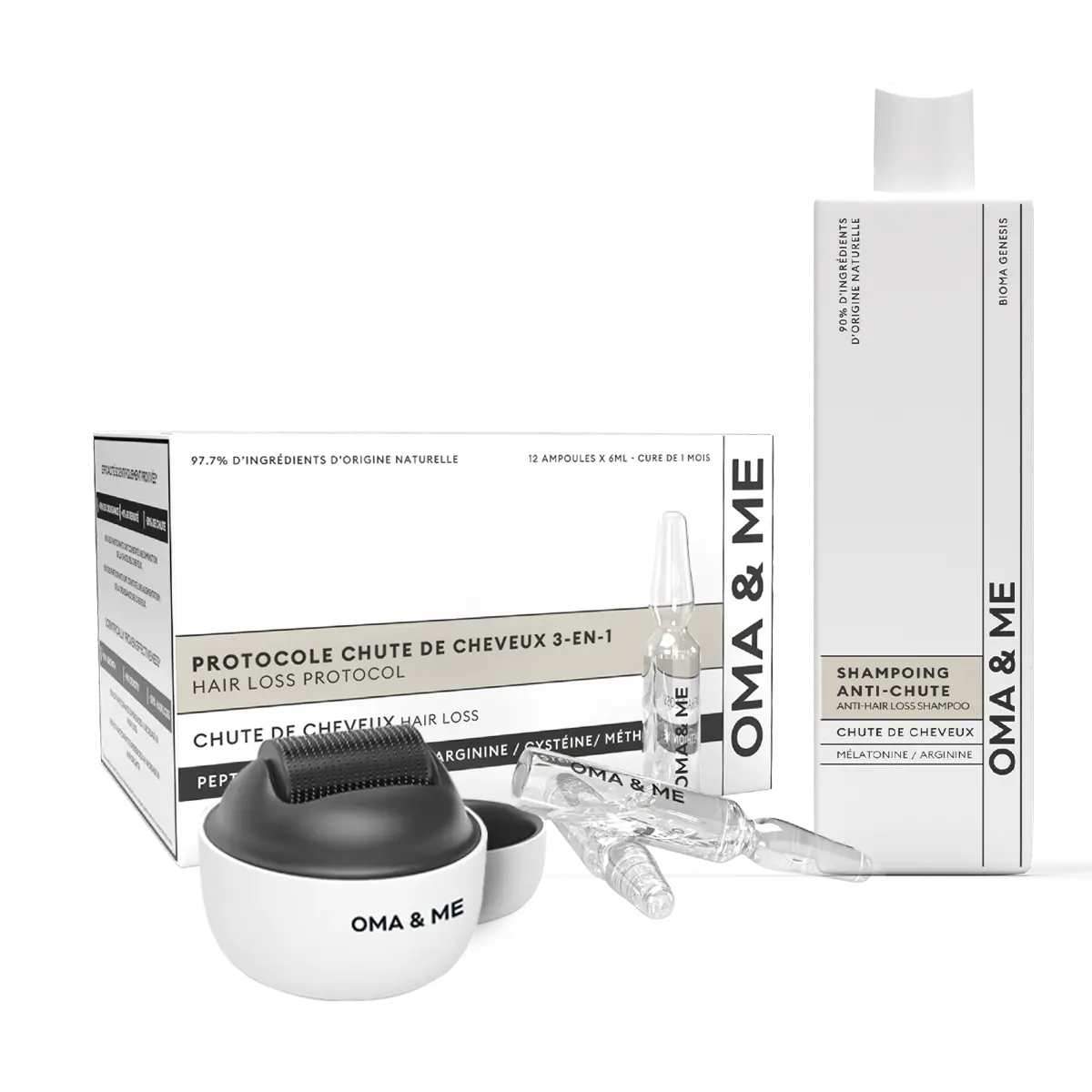
8. An alternative available right now: the OMA & ME 3-in-1 Protocol
9. Sources
1. Hair cloning vs hair transplant: what's the difference?
Before going any further, it's worth clearing up a common misconception.
A hair transplant involves relocating existing follicles from a donor area (typically the back of the scalp) to a thinning zone. It doesn't create new hair — it redistributes a finite supply.
Hair cloning aims at something fundamentally different: increasing the number of available follicles, by multiplying or recreating them from cells.
On paper, that's what makes it potentially revolutionary. In practice, delivering on that promise involves enormous scientific challenges.
2. What exactly is hair cloning?
The term "hair cloning" doesn't refer to a single technique — it covers a broad field of research within regenerative medicine.
The general idea is to:
- harvest cells involved in hair growth,
- multiply or reprogram them in a laboratory,
- then reimplant them to recreate or reactivate follicles.
Unlike a transplant, the goal isn't to relocate — it's to reconstruct or regenerate.
3. How a hair follicle works (simplified)
A hair follicle operates like a small factory — and that factory has a conductor: the dermal papilla.
These specialised cells send signals that:
- trigger the hair growth phase,
- regulate hair thickness,
- and control the hair's life cycle.
In androgenetic alopecia, the follicle isn't "dead" from the outset — it progressively miniaturises. Hair cloning research therefore seeks either to restore the inductive power of these cells, or to generate new ones entirely.
4. The main approaches to hair cloning
A. Dermal papilla cell expansion
Cells are harvested, multiplied in a laboratory, then reinjected. The problem: once removed from their natural environment, these cells tend to lose their ability to induce hair growth.
B. Follicular neogenesis
This approach aims to recreate a complete follicle from scratch. It works in experimental models, but has proven extremely difficult to replicate reliably in humans.
C. iPSCs and organoids
Cells are reprogrammed to revert to a stem-cell-like state, then organised into follicular structures. This is the most ambitious approach — and the most complex.
D. Follicle banking
Some companies offer to preserve young follicles for future use. However, this does not yet constitute a treatment in any meaningful sense.
5. Why hair cloning is so complex
The core obstacle is scientific: an isolated cell does not behave the same way as it does within its natural environment.
Researchers need to recreate:
- a three-dimensional architecture,
- precise biochemical signals,
- and fine-tuned communication between multiple cell types.
This is why spectacular laboratory results have not yet translated into standardised treatments.
6. Where research actually stands today
Progress is real, but measured:
- solid evidence exists primarily at the laboratory level,
- human trials remain limited and exploratory,
- many announcements are based on company communications rather than robust clinical publications.
Hair cloning is a scientifically credible avenue — but not yet an accessible solution.
7. When will hair cloning be available?
Today, there is no validated hair cloning treatment available to the general public. These approaches also require strict protocols and lengthy regulatory validation before any market launch.
The most realistic near-to-medium-term advances are more likely to involve:
- slowing the miniaturisation process,
- supporting follicles that are still active.
Creating new, fully functional follicles at scale remains a long-term objective.
8. An alternative available right now: the OMA & ME 3-in-1 Protocol
While regenerative medicine solutions continue to develop, there are already non-pharmaceutical approaches designed to support the follicular environment.
The OMA & ME 3-in-1 Hair Loss Protocol combines actives targeting:
- the hair growth cycle,
- scalp balance,
- and the quality and resilience of existing hair.
It is primarily aimed at those who still have active or miniaturised follicles, and works on a logic of preservation and optimisation — complementary to whatever advances the future may bring.

Important: if hair loss is rapid, extensive or unusual, always consult a dermatologist before modifying or adding any treatment.
9. Sources
- PubMed reviews on the dermal papilla and follicular neogenesis.
- Publications on stem cells and iPSCs in dermatology.
- Scientific communications from the Stemson and HairClone programmes.
-
Example product title
Regular price €19,99Sale price €19,99 Regular priceUnit price per -
Example product title
Regular price €19,99Sale price €19,99 Regular priceUnit price per -
Example product title
Regular price €19,99Sale price €19,99 Regular priceUnit price per


