
The Taiwan Hair Regrowth Serum: What the "20-Day" Study Really Shows
FEATURE – A finding that's been making waves in the media: a serum developed in Taiwan that could reportedly regrow hair in just 20 days. This surprising discovery comes from a Taiwanese research team, who observed spectacular hair regrowth in mice using a novel biological approach. What does the study actually say — and should it be seen as a miracle cure for human baldness?

Table of Contents
1. What is this discovery?
2. How does this serum work?
3. What the mouse experiments show
4. What does this serum contain?
5. What about in humans?
6. What are the next steps?
7. Comparison with current treatments
8. Key takeaways
9. An alternative available today
10. Sources
1. What is this discovery?
This study was conducted by researchers at National Taiwan University (NTU) and published in late October 2025 in Cell Metabolism. Their goal: to understand how certain immune system signals can "wake up" dormant hair follicles. The scientists observed that in mice, certain active skin reactions trigger a cascade of chemical signals capable of relaunching hair growth — in as little as 20 days.
2. How does this serum work?
It starts with a striking observation: when a small inflammatory reaction occurs on the skin's surface, immune cells called macrophages migrate to the site and release molecules that activate fat cells in the dermis (adipocytes). These cells then release monounsaturated fatty acids (such as oleic and palmitoleic acid), which "fuel" the stem cells of the hair follicle, reigniting activity via a molecule called PGC-1α. In plain terms: the hair follicle "restarts its engine."
The researchers' serum replicates this metabolic mechanism — without inflammation.
3. What the mouse experiments show
The researchers applied the solution to shaved mice. Result: hair began regrowing by day 10, with full coat coverage achieved in around 20 days. Placebo mice showed no notable regrowth in the same period. The effect also disappeared when the researchers blocked lipolysis, confirming the key role of this mechanism. Study images show dense, even, and rapid regrowth with no sign of adverse tissue effects.
4. What does this serum contain?
The experimental serum contains primarily monounsaturated fatty acids (MUFAs) — notably oleic acid (found in olive oil) and palmitoleic acid. These substances are naturally produced by the body, but in insufficient quantities in thinning areas. Applied topically, they act as "metabolic fuel" to restart dormant follicles — without hormones or vasodilating molecules like minoxidil.
5. What about in humans?
To date, no clinical trial in humans has been published. Efficacy observed in mice does not guarantee the same response in humans — our follicles are more complex, and the mouse hair cycle is far shorter. Formulation and optimal dosing for human scalp application also remain to be determined. The NTU team has filed an international patent and plans tolerance tests.
6. What are the next steps?
Researchers must confirm cutaneous safety, local absorption, and verify no systemic entry. If favourable, a Phase 1 clinical trial could begin within years. In typical timelines, 7 to 10 years would be needed before any market launch — but this approach opens an entirely new avenue: the metabolic reactivation of dormant follicles.
7. Comparison with current treatments
| Treatment | Mechanism | Time to effect | Limitations |
|---|---|---|---|
| Minoxidil | Vasodilation and local stimulation | 3–6 months | Moderate effect, daily application |
| Finasteride | DHT hormone blocker | Several months | Possible hormonal effects |
| Hair transplant | Transfer of existing follicles | 6–12 months | Invasive surgery, high cost |
| NTU serum (in study) | Metabolic activation via fatty acids | 20 days (in mice) | No human data yet |
8. Key takeaways
- An experimental serum developed in Taiwan produced hair regrowth in mice within 20 days.
- The mechanism relies on metabolic stimulation of follicles via naturally occurring fatty acids.
- This is a preclinical result: no human study has confirmed the effect, and Phase 1 has not launched — a product launch remains at least 7 to 10 years away.
- If next steps prove conclusive, this could inspire a new generation of non-hormonal topical treatments.
9. An alternative available today
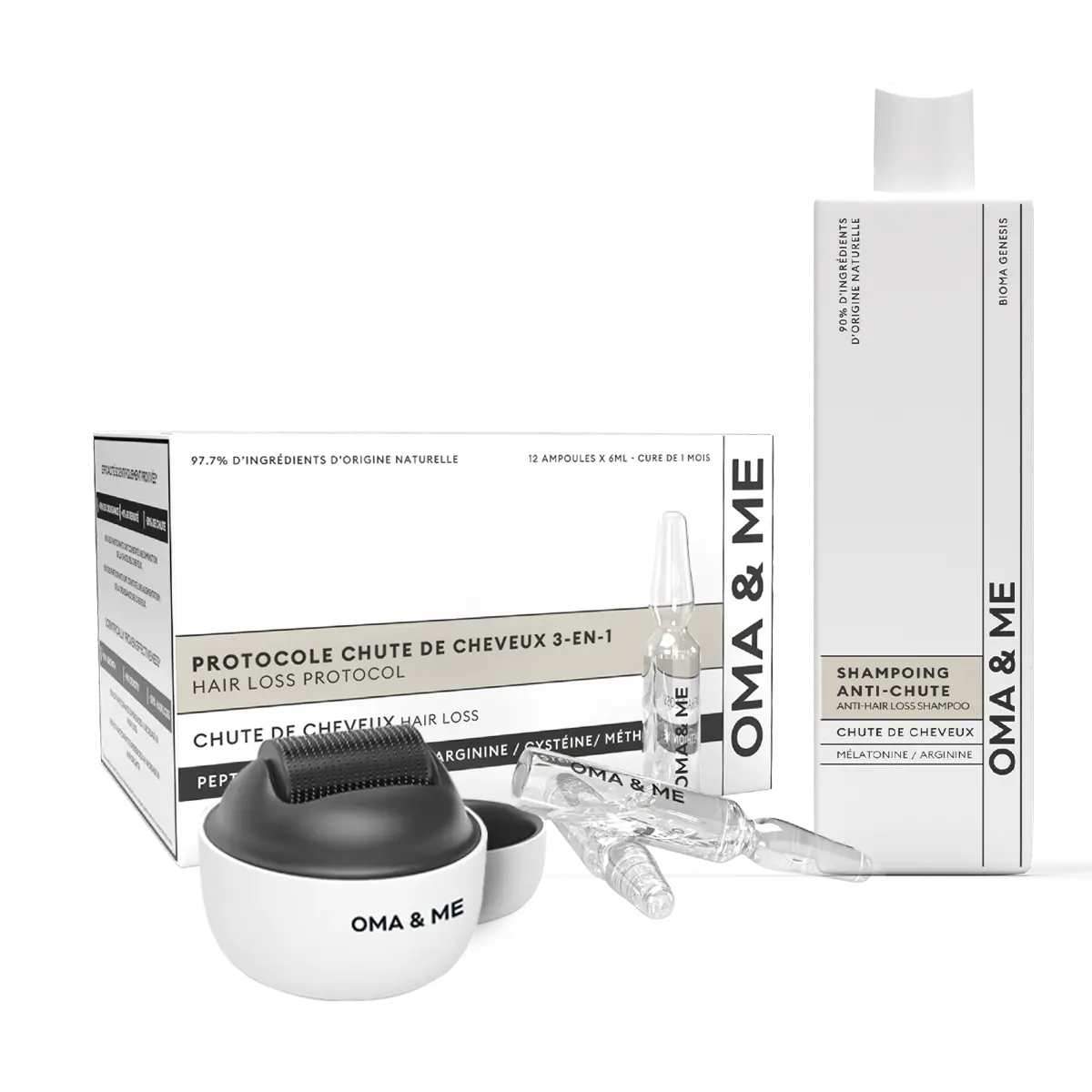
While potential human applications develop, you can act now with the OMA & ME 3-in-1 Hair Loss Protocol — a non-pharmaceutical, scientifically supported approach. It combines pre- and post-biotics, amino acids, zinc, and melatonin to stimulate regrowth and rebalance the scalp. Recommended use: 3 applications per week for 3 months, ideally with a derma roller.

Important: if hair loss is rapid, diffuse, or unusual, consult a dermatologist before starting any new treatment.
10. Sources
- Lin, S.-J. et al. (2025). "Macrophage-induced adipocyte lipolysis activates follicular stem cells via fatty acid metabolism." Cell Metabolism, 22 October 2025.
- ScienceAlert – "Scientists Create Serum That Makes Hair Grow Back in 20 Days" (2025).
- Newsweek – "Baldness Breakthrough: Hair Regrowth Serum Developed in Taiwan" (2025).
-
Example product title
Regular price €19,99Sale price €19,99 Regular priceUnit price per -
Example product title
Regular price €19,99Sale price €19,99 Regular priceUnit price per -
Example product title
Regular price €19,99Sale price €19,99 Regular priceUnit price per


